
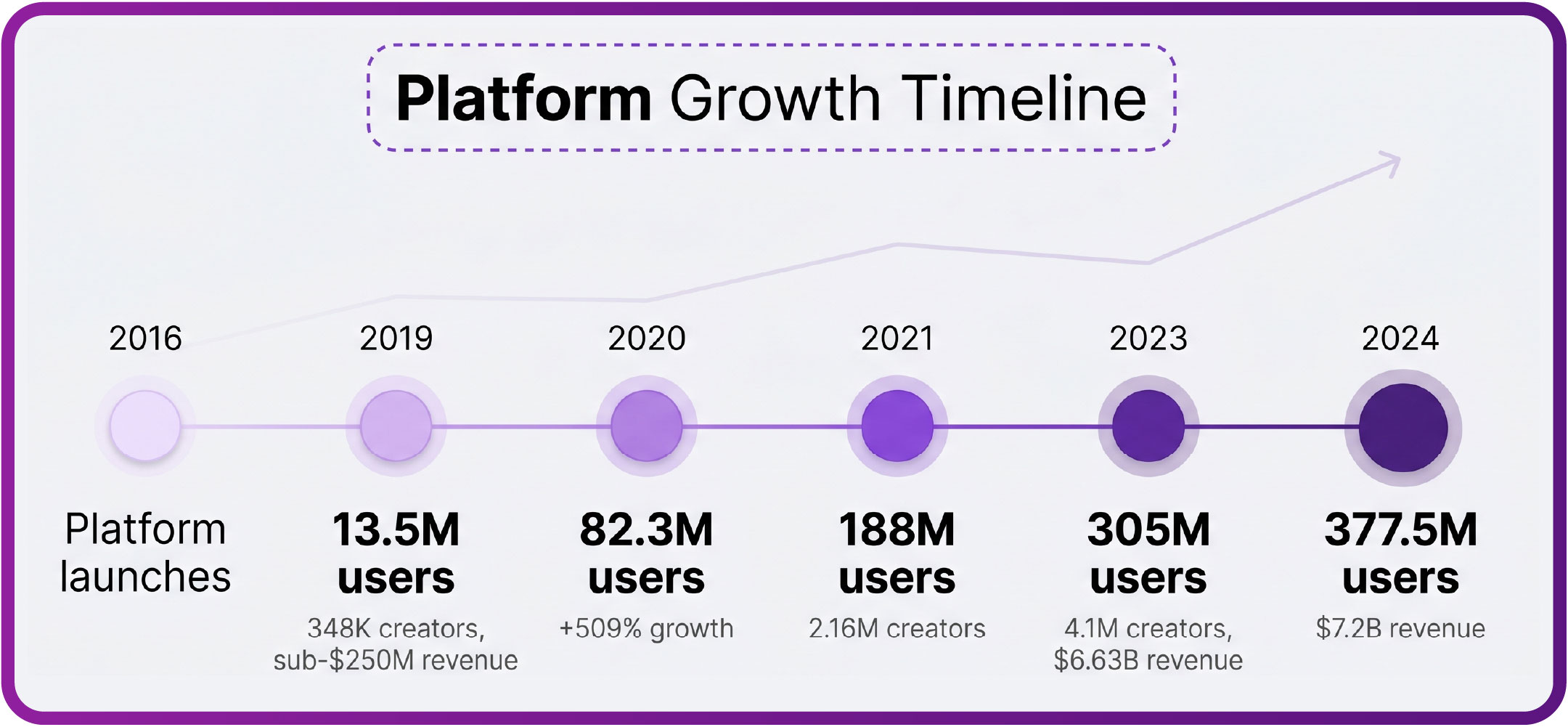
OnlyFans operates as a behavioral economy where individual subscriber decisions aggregate into platform-wide patterns. BestOnlyFans examines how millions of micro-interactions—subscriptions, cancellations, tips, and purchases—collectively shape pricing structures and creator strategies. This analysis applies behavioral economics frameworks to reveal the invisible forces driving platform dynamics.
Platform Growth Trajectory
The platform’s growth trajectory illustrates this collective behavior effect. User expansion has created increasingly segmented subscriber populations with distinct spending profiles and lifecycle patterns that creators must navigate.

The Concentration of Spending Among Heavy Users
Platform revenue follows a classic Pareto distribution where approximately 20 percent of subscribers generate roughly 80 percent of creator income. This concentration creates structural dependencies that influence pricing psychology and content prioritization.
Heavy User Behavioral Patterns
Heavy users demonstrate fundamentally different behavioral patterns than casual subscribers. Their platform engagement spans longer sessions, higher message response rates, and elevated custom content request frequency.
- Top 10% of subscribers by platform-wide spend
- Heavy users averaging 5-15+ active subscriptions simultaneously
- Disproportionate tip and PPV contribution from high-engagement minority
- Creator revenue dependence on whale subscribers
- Platform algorithmic prioritization of high-lifetime-value accounts

This concentration creates risk for creators who build revenue models around limited subscriber bases. A creator with fifty subscribers might derive 60 percent of income from just three accounts, making churn events financially significant despite modest follower counts.
Churn Patterns and the First Month Effect
Subscriber lifecycle analysis reveals predictable abandonment curves that shape creator content calendars and promotional strategies. The first thirty days determine long-term retention probability with remarkable consistency.
Four Churn Phases
- Promotional month exploitation with immediate cancellation
- Second-month price shock and cancellation spike
- Three-month habit formation or abandonment decision point
- Six-month+ loyalty with reduced price sensitivity
Promotional pricing—often $3 for month one before reverting to $9.99 or higher—triggers specific behaviors. Subscribers who join at promotional rates show elevated cancellation rates before renewal, treating the discount as a limited trial rather than commitment.

Creators respond by front-loading value: comprehensive welcome messages, immediate access to back catalogs, and personalized onboarding. This reflects rational adaptation to subscriber attention structures.
Concrete guidance: Track your Day-7, Day-14, and Day-28 engagement metrics separately. Subscribers who interact minimally in week one show 70 percent higher cancellation probability regardless of subsequent content quality delivered.
Seasonal and Cyclical Demand Variations
Subscriber spending exhibits predictable annual rhythms that creators anticipate in planning and pricing. These patterns reflect broader discretionary spending constraints rather than platform-specific factors. The January effect proves pronounced: gift subscriptions purchased in December create artificial subscriber spikes followed by elevated cancellation rates when recipients discover the charge. Creators often run “keep me” campaigns targeting this specific window.
January Effect and Annual Patterns
Five Annual Spending Patterns
- January spending contraction post-holiday creates the most disruptive pattern, with subscriber counts dropping 20-30% as gift recipients cancel and budget discipline resumes.
- Tax refund season from March through May sees measurable spending increases as refund deposits expand discretionary budgets.
- Summer months typically show 15-25 percent engagement reductions as vacation patterns disrupt consumption habits.
- Back-to-school budget reallocation in August-September redirects household spending away from discretionary subscriptions.
- December gift subscription purchases generate January churn that creators must offset through retention incentives.
Tax season represents the strongest organic growth window outside promotional periods. Creators who align premium content releases with March-May refund cycles capture expanded spending capacity without discounting.
Engagement Depth Beyond Base Subscriptions
Platform economics extend far beyond monthly subscription fees. Behavioral segmentation reveals three distinct subscriber categories with radically different revenue profiles and creator interaction patterns.
| Subscriber Type | Monthly Spend Profile | Creator Response Pattern |
|---|---|---|
| Passive Subscriber | Base subscription only ($4.99-$9.99) | Automated welcome sequence, minimal direct interaction |
| Moderate Engager | Base plus occasional PPV ($15-$30) | Periodic personalized messages, loyalty rewards |
| High-Activity Participant | Base plus tips, PPV, custom requests ($50-$200+) | Priority response, exclusive content access, direct communication |
This segmentation explains why identical subscription prices generate vastly different creator incomes. Two subscribers at $9.99 monthly might produce $10 or $150 in actual revenue depending on engagement depth.

Custom content requests—priced individually from $15 to $500 depending on complexity—represent the highest-margin revenue category. Their incidence correlates strongly with subscriber tenure, suggesting relationship depth enables premium transaction willingness.
Payment Method Choices and Platform Risk
Subscriber payment selections reveal sophisticated risk management strategies. The $0.10 verification hold—refunded within days—triggers varying responses based on subscriber privacy preferences and spending control priorities.
Five Risk-Management Behaviors
- Dedicated low-limit cards for subscription control
- Virtual card numbers for single-creator commitments
- Prepaid cards to enforce hard spending caps
- Separate checking accounts for discretionary spending isolation
- Cryptocurrency avoidance due to platform non-acceptance
These choices reflect rational responses to platform characteristics: recurring billing, statement descriptor visibility, and psychological separation of discretionary spending. Virtual card prevalence specifically indicates demand for subscription-specific commitment devices.
Privacy-Seeking Behavior and Its Tradeoffs
Anonymity preferences shape subscriber behavior across multiple dimensions, creating measurable friction in platform interaction. Privacy desires conflict with features requiring verified identity or persistent identity signals.
| Privacy Tactic | Protection Gained | Functionality Sacrificed |
|---|---|---|
| Anonymous email address | Identity unlinking from personal accounts | Account recovery options limited |
| VPN usage | Geographic obfuscation | Some payment processors block VPN-flagged transactions |
| Prepaid cards | Spending caps and statement anonymity | Auto-renewal unavailable; manual resubscription required |
| Pseudonymous accounts | Social separation | Reduced creator trust; fewer custom content opportunities |
The prepaid card tradeoff proves particularly significant: subscribers sacrifice convenience for control through hard spending limits and statement privacy. This creates predictable churn patterns around payment expiration that creators observe as “silent cancellation.”

Dispute behavior shows similar privacy correlation: subscribers using identity-obscuring payment methods file fewer chargebacks, possibly reflecting selection effects rather than causal relationships.
Cross-Platform Subscription Portfolios
OnlyFans subscribers rarely limit spending to single platforms. Behavioral analysis reveals systematic multi-platform portfolios that allocate attention and budget across complementary services.
Five Common Platform Combinations
- OnlyFans paired with Fansly enables creator diversification across similar subscription models.
- Patreon supplementation addresses non-explicit content preferences.
- Twitch subscriptions satisfy live interaction demands.
- Discord Nitro purchases provide community access infrastructure.
- Gumroad transactions allow one-off content acquisition without ongoing commitment obligations.
This portfolio approach suggests subscribers conceptualize spending categorically rather than platform-specifically. The same individual maintains discrete mental accounts for “direct creator support,” “community membership,” and “content purchase” that cross platform boundaries.
Platform Pricing Constraints and Creator Mobility
Platform-switching costs remain low given similar content formats, enabling subscriber migration based on creator presence rather than platform features. This fluidity constrains platform pricing power and drives creator-centric competition.
OnlyFans has no built-in discovery feed or directory—this structural absence explains why ranking sites and external discovery mechanisms have proliferated. Subscribers seeking new creators rely on third-party curation rather than platform recommendation, fundamentally altering how creator visibility gets constructed.
The pricing implication proves significant: platforms cannot easily raise take rates because creators retain credible exit threats toward competitors. The 20% platform fee has remained stable partly because higher rates would trigger measurable creator migration to alternatives with lower commissions, even with smaller audiences.
BestOnlyFans and Behavioral Data Integration
Ranking methodologies increasingly incorporate anonymized behavioral signals alongside surface metrics. BestOnlyFans utilizes pattern recognition across subscriber actions—retention duration, spending velocity, engagement depth—to forecast creator revenue sustainability.
This approach distinguishes between high-follower creators with shallow engagement and lower-follower creators with concentrated, loyal subscriber bases. The latter often demonstrate superior long-term economics despite smaller audience sizes.
Understanding these dynamics helps subscribers evaluate where spending creates most value and assists creators in optimizing for sustainable income rather than vanity metrics. The behavioral data reveals that top only fans creator rankings reflect composite signals including retention-adjusted revenue and engagement quality, not raw follower counts.
the ranking site Methodology Components
The methodology emphasizes that creator success depends on matching content output to subscriber behavioral segments. Creators optimizing solely for subscription acquisition neglect the engagement depth that actually generates platform economics.

Security and Transparency Incentives
Security-conscious subscribers increasingly verify creator authenticity through ranking platform assessments, creating feedback loops where behavioral transparency becomes competitive advantage. This shifts creator incentives toward sustainable practices.

FAQ
Do creators know which subscribers are high spenders across multiple pages?
Individual creator dashboards show only spending behavior on that specific page, not platform-wide patterns. Creators see total tips, PPV purchases, and message frequency for their own content exclusively. They cannot identify whether a subscriber maintains five subscriptions or fifty, though elevated engagement on their page often correlates with broader platform activity.
Why do so many OnlyFans promotions target the first month specifically?
The promotional structure exploits first-month behavioral economics. Promotional first months can drop below the $4.99 minimum—commonly to $3—while base prices must remain at $4.99 or higher. Subscribers exhibit highest price sensitivity at subscription initiation, before habit formation and sunk cost effects develop. First-month discounts lower entry barriers while eventual price reversion captures less price-sensitive subscribers who remain. When a creator raises the price, auto-renew stops and existing access lasts until the paid period ends, making month-two retention rates a critical indicator of long-term subscriber value.
How does OnlyFans detect and respond to chronic churn-and-return subscribers?
Platform systems track subscription patterns including cancellation timing, re-subscription intervals, and promotional exploitation. Repeat promotional exploiters—subscribing at discount, canceling, waiting for next promotion—may find promotional offers withheld or account restrictions applied. The specific thresholds remain non-public to prevent gaming. Creators generally lack visibility into these patterns for individual subscribers.
Can this directory identify creators who retain subscribers longer than average?
Retention analysis forms a core ranking component. The methodology weights subscriber lifecycle metrics alongside acquisition rates to surface creators demonstrating sustainable engagement. Long-tenure subscriber bases indicate content consistency and community building rather than viral attraction alone. These signals prove particularly valuable for subscribers seeking ongoing relationships rather than transactional content access.